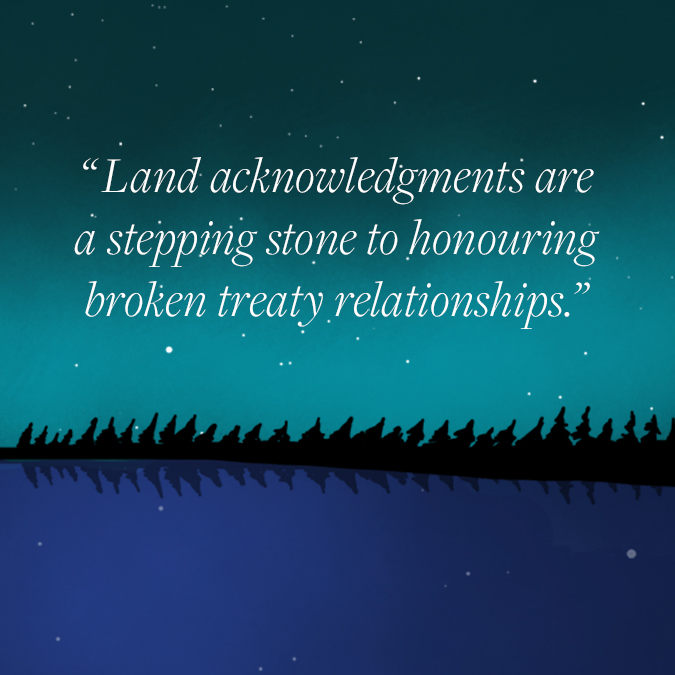
The Territory Acknowledgement Resource:
We talked about the Territory Acknowledgement Information Booklet, and in class, we got the chance to look over this great resource.
This resource summarizes a territorial acknowledgement as a ‘relational process, which means that the meaning and purpose of it changes across time and space, and with the specific context in which it takes place’ (p. 2).
It goes over the importance of acknowledging the territory you are on, in a respectful and authentic way. A quote that resonated with me is: ‘The focus on acknowledging land and territory rather than just First Nations culture and identity is significant. First Nations peoples are not merely one of many cultural groups and ethnicities in a multicultural vision of Canadian society, and it is impossible to talk about Indigenous-specific anti-racism without talking about European imperialism and the theft of land and displacement of communities and Nations’ (p. 4). This quote is important to me because it recognizes the acknowledgement of land in a non pan-Indigenized way, while also talking about the importance of recognizing the past.
This resource then goes over some tips on how to do a Territory Acknowledgement, which I found extremely helpful. I loved that it gave me easy bullet points to consider.
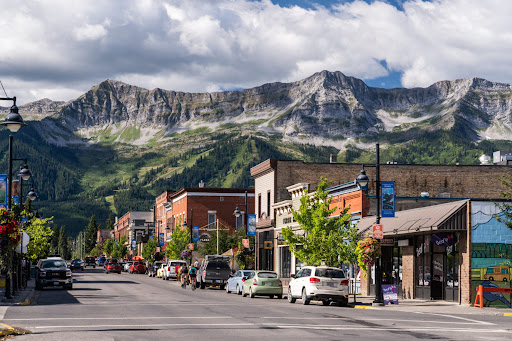
Image source: Kootenay Rockies
What Resonated With Me?
Firstly, something that resonated with me is how in the examples of opening a meeting with a territorial acknowledgement, they included a section where the person speaking acknowledged their own ancestry/heritage before mentioning the land that they are on. I found this really interesting, I have never heard someone do this before a territorial acknowledgement, and it is something that I will think on moving forward.
Secondly, something that I had not thought of was a note in the document, saying that when you are listing multiple Indigenous groups, you should list them alphabetically as to not imply a hierarchy. I had never thought about this before, and it is really good to be made aware of.
I also loved that the document mentions following up the acknowledgement with a conversation on what that group can do to address systemic racism, or help in de-colonial efforts and support First Nations sovereignty (p. 10). I think that this greatly connects to teacher competency #10, “Engage critically and creatively with ideas to be a change agent in society, especially with regard to equity and justice”. I think that this connects well because bringing up these hard conversations is what we need to do in order to recognize our past as Canadians, and I think that it is a stepping stone to being a ‘change agent’.
I also loved how it clearly explained the term ‘unceded’ and talked about how ‘much of the First Nations territory in BC is ‘unceded’, which means it was never legally ceded, or given up to the crown, through treaty or other arrangements’ (p. 11). This clarification made things a lot clearer for me and also the importance of recognizing traditional territories as unceded.

Image source: The Eblin Group
judi61
March 20, 2026 — 9:15 am
Jenna,
Thank you for this thoughtful reflection. There is so much to know with regards to T & R and Calls to action and your thoughts on Territorial Acknowledgement were personal and actionable as you take the steps towards knowing better, hence doing better!
Lovley post!