What is Boud’s reflective cycle?
Boud’s triangular model shows learning as an ongoing process that grows out of experience and reflection. It’s simple and easy to understand, but it doesn’t really explain how reflection should happen or how new learning feeds back into future experiences. Including more structured reflective prompts would help make the model easier to use in practice.
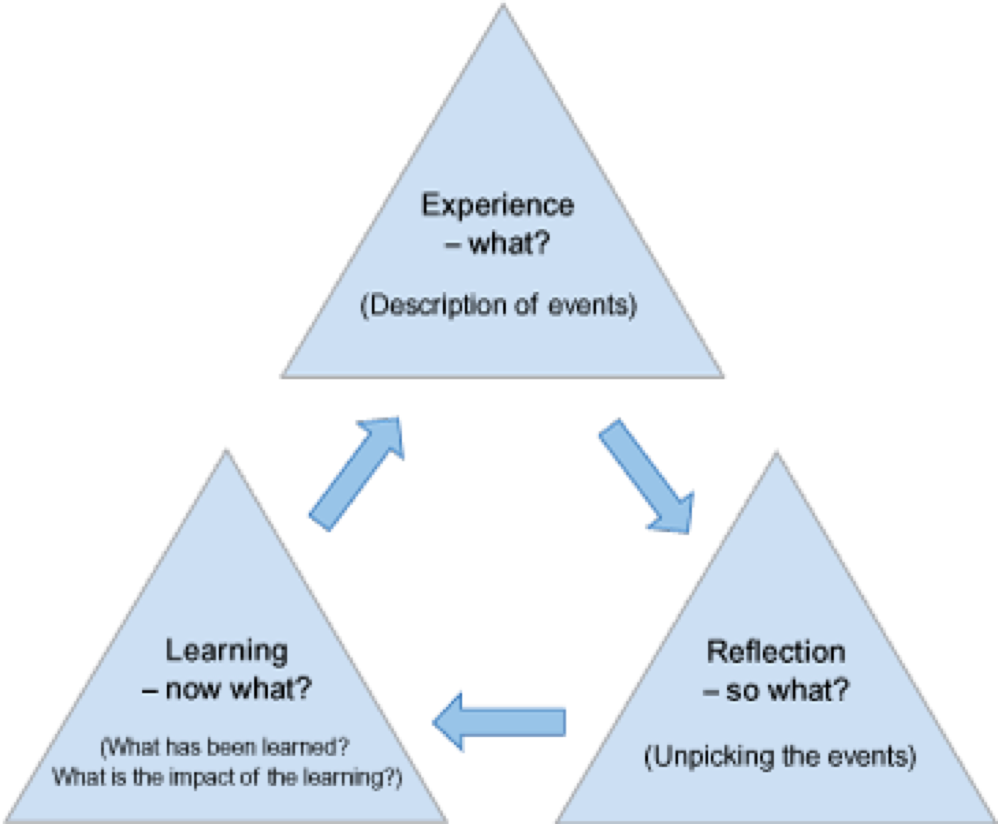
Visual of the Boud’s reflective model
What is Gibbs reflective cycle?
Gibbs’ reflective cycle lays out reflection in clear steps and recognises that feelings matter when making sense of experiences. It builds on Boud’s model by helping connect what was evaluated and analysed to what you might do next. While it doesn’t push hard on deep critical questioning or major change, it offers a helpful starting point that can be built on to support more meaningful reflection in practice.
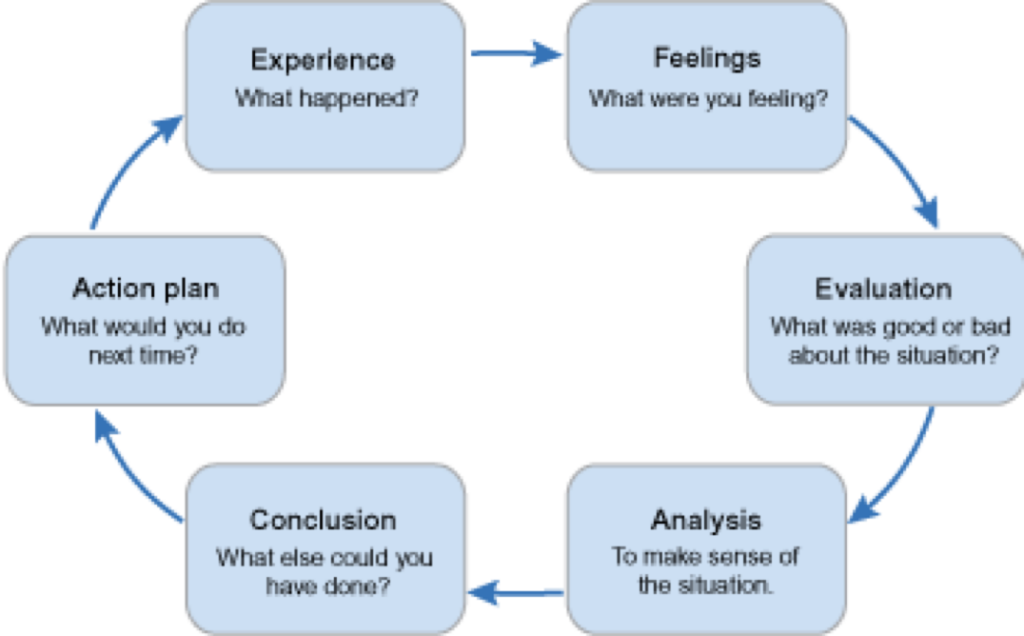
A comparison of Boud’s and Gibb’s reflective cycles:
Boud’s and Gibbs’ models both focus on how experience, reflection, and learning connect, but they differ in how much direction they give. Boud’s model is quite open-ended and conceptual, offering a general idea of reflection without clearly explaining how to do it or how learning should influence future practice. Gibbs’ cycle, on the other hand, is more structured and includes a focus on feelings, which can help guide reflection in a clearer way. However, even with this added structure, Gibbs’ model can still become quite descriptive, as neither model fully pushes for questioning assumptions, considering different perspectives, or making clear changes to practice.
Reflecting on an experience using Gibb’s:
The experience (what happened):
The experience I will be reflecting on is a math lesson I taught last semester. I was teaching an eighth-grade math lesson at Laurie Middle School with my co-teaching partner. This lesson focused on decimals, specifically adding tax and calculating sale prices and discounts. Just minutes before the lesson began, my teaching partner had an anaphylactic reaction and had to step away. Since we had planned to split the lesson evenly, I felt confident teaching my own portion but was suddenly responsible for content I hadn’t prepared in the same depth. This unexpected situation pushed me to adapt quickly and manage the lesson independently.
Feelings:
At first, I felt stressed and overwhelmed. The timing made it especially challenging because there was no opportunity to regroup or adjust the plan ahead of time. I was also concerned about keeping the lesson clear and engaging for students while managing my own nerves. At the same time, I felt a sense of responsibility to keep things running smoothly for the class.
Evaluation:
Despite the circumstances, the lesson continued and students were able to work through the tasks. Some parts went well, particularly the sections I had prepared, where I felt more confident and clear in my explanations. However, during the parts I was less familiar with, I noticed myself looking at the lesson plan more than I wanted to, and coming up with ideas on the spot.
Analysis:
This experience highlighted how dependent our planning had been on splitting responsibilities rather than fully understanding the lesson as a whole. While co-teaching can be effective, this situation showed the importance of being flexible and having a solid grasp of all lesson components. It also reinforced how quickly unexpected situations can arise in a classroom and the need to adapt in the moment.
Conclusion:
Overall, the experience was challenging but valuable. It pushed me outside my comfort zone and showed me that I am capable of adjusting when plans change suddenly. It also made clear that deeper preparation across all lesson components would have increased my confidence and effectiveness.
Action Plan:
In the future, when co-planning lessons, I will make sure I understand all parts of the lesson, even if responsibilities are shared. I will also prepare a few flexible strategies, such as extra examples or guided practice questions, that can be used if plans change unexpectedly. This will help me feel more confident and better prepared to respond to unforeseen situations in the classroom.
Linking to a teacher competency:
I think that this experience really connects to Teacher Competency #9, which focuses on demonstrating a deep understanding of overarching disciplinary concepts. Being required to teach the entire lesson on decimals, including tax, discounts, and sale prices, pushed me to rely on my understanding of the big ideas in mathematics rather than a scripted plan. Instead of simply following prepared steps, I had to draw on my conceptual understanding of how decimals operate in real-world contexts and explain these ideas clearly to students. This highlighted the importance of understanding the underlying concepts, as it allowed me to adapt explanations, model thinking aloud, and respond to student questions even when I was less prepared. The experience reinforced that strong content knowledge is essential for flexible and responsive teaching, particularly when unexpected situations arise.
Images provided by Judi’s slideshow presentation
judi61
February 17, 2026 — 3:19 pm
Jenna, when you mention that you needed to demonstrate a deeper understanding of overarching disciplinary concepts and the big idea of a concept when faced with teaching the other part to someone’s lesson, you are spot on! It is easier to pivot when faced with a hiccup, if you have grasped a whole concept rather than than only being the expert on a piece of a lesson and having to teach it all. This why the rationale of the a concept is important as it deals with the purpose. After that the ‘how’ piece becomes easier!
I hope that this makes sense!
Judi